  |
Intact
HCG and Related Molecular Forms
Introduction
Human chorionic gonadotropin (HCG), a protein hormone that stimulates
progesterone secretion, appears in biological fluids as intact HCG, free
alpha subunit, free beta subunit, and various fragments such as nicked
HCG and nicked free beta-HCG. For more than 25 years, researchers have
investigated the molecular forms of HCG in pregnancy and in different
physiopathological processes, including trophoblastic diseases, testicular
cancers, and nongonadal and nonplacental tumors. Immunological HCG measurements
contribute much to understanding the structure, metabolism and clinical
significance of the molecules, but immunoassay specificities for different
forms must be identified in order to produce consistent and reliable results.1
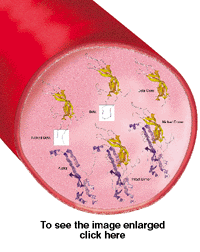 Figure
1. Among the several HCG forms that appear in the blood are free alpha
subunit, free beta subunit, nicked free beta (with cleavage sites--between
amino acids 47 and 48, 43 and 44, or 44 and 45--in blue), intact dimer,
nicked dimer (includes nicked beta subunit), and beta-core fragment (amino
acids 6 ‚ 40 and 55 ‚ 92). Figure
1. Among the several HCG forms that appear in the blood are free alpha
subunit, free beta subunit, nicked free beta (with cleavage sites--between
amino acids 47 and 48, 43 and 44, or 44 and 45--in blue), intact dimer,
nicked dimer (includes nicked beta subunit), and beta-core fragment (amino
acids 6 ‚ 40 and 55 ‚ 92).
Structure
of HCG
HCG is a dimer consisting of two noncovalently associated, dissimilar
subunits. Both the pituitary gland and placental tissue express the alpha
subunit (92 amino acids; MW 14.5 kDa), which is immunologically indistinguishable
from the alpha subunits of the other pituitary glycoprotein hormones (namely
luteinizing hormone, LH; follicle stimulating hormone, FSH; and thyroid
stimulating hormone, TSH). The HCG beta subunit (145 amino acids; MW 22.2
kDa) determines the biological and immunoreactive uniqueness of the intact
HCG molecule. While the beta subunit closely resembles the beta subunit
of LH (the molecules are identical in 97 of 121 amino acids), beta-HCG
differs in its serine-rich, extended, carboxyl-terminal (C-terminal) peptide
(24 amino acids). Antibodies developed against the C-terminal peptide
crossreact with LH minimally or not at all. The C-terminal antibodies
prove useful in measuring low HCG concentrations present at early stages
in pregnancy and in ectopic pregnancies. Researchers have found increased
free beta-HCG levels in patients with malignant tumors, suggesting clinical
implications for the molecule.2
The
other identified HCG forms have limited (< 20%) or no biological activity.3-5
Nicked HCG has a cleavage site in the beta chain between amino acids 47
and 48 (or less commonly between positions 43 and 44 or 44 and 45). Circulating
nicked HCG levels rise throughout pregnancy, increasing to about 9 percent
of the total HCG by the second month and to about 21 percent at term.
Nicked free beta-HCG appears in the circulation as well. The main degradation
product of beta-HCG is the beta core fragment, which is measurable only
in urine and which goes by a variety of names in the literature, including
urinary gonadotropin peptide (UGP).
Total
HCG Assay
The ratio of nicked and intact HCG concentrations differs among diseases
and varies throughout the course of some diseases. Accurate diagnoses
depend on total HCG measurements, including both nicked and intact forms.
Total HCG assays should measure both intact and nicked forms of HCG and
the free beta subunit. Many immunoassays do not detect nicked HCG forms.
Dr. Van Ingen and coworkers (Rotterdam, The Netherlands) demonstrated
that IMMULITE® HCG recognizes both the intact and nicked forms (abstract
accepted for presentation at the 1998 annual meeting of the AACC). The
researchers measured HCG concentrations in pooled serum samples using
several immunoassay systems. They spiked the samples with identical mass
concentrations of either HCG or nicked HCG. Table 1 lists the results,
expressed as HCG concentration relative to IMMULITE HCG. While IMMULITE
HCG detects nicked and intact forms, the other automated immunoassays
detect only a small percentage of nicked HCG.
Table
1.
Assay
|
HCG(%)
|
Nicked
HCG (%)
|
| IMMULITE
HCG |
100 |
129 |
| IMx
Total beta-hCG |
113 |
55.7 |
| IMx
hCG |
79.9 |
11.7 |
| MAIAclone
hCG + beta |
91.6 |
4.5 |
| ACS
HCG + B |
74.5 |
12.9 |
| Elecsys
hCG |
87.1 |
3.1 |
Reactivities
of several immunoassay systems expressed as HCG concentrations (by mass)
relative to IMMULITE® HCG results (= 100%).
DPC
Assays for HCG and Free Beta-HCG
The IMMULITE HCG assay (described by Vankrieken et al.)6 has a calibration
range of up to 5,000 mIU/mL (3rd IS 75/537), with a detection limit of
approximately 1.1 mIU/mL. The assay exhibits no high-dose hook effect
at HCG levels as high as 2,000,000 mIU/mL. FSH, LH and TSH do not crossreact.
Reactivity of the beta subunit of HCG is approximately 130%. This assay
therefore measures intact HCG as well as the free beta subunit of HCG.
In addition, IMMULITE HCG also measures nicked HCG and nicked free beta-HCG
(DPC data on file). Accurate and precise total HCG results are available
on the IMMULITE analyzer in 40 minutes.
The
IMMULITE Free Beta HCG assay* is a solid-phase, two-site sequential chemiluminescent
immunometric assay, with a calibration range of up to 80 ng/mL (80 mIU/mL,
1st IRP 75/551), and a detection limit of approximately 0.02 ng/mL. Crossreactivities
of intact HCG, free alpha-HCG, LH beta subunit and TSH beta subunit are
approximately 0.089%, 0.15%, 0.4% and 0.002%, respectively. No crossreactivity
has been observed with FSH, FSH beta subunit or TSH. Due to the binding
sites determined by epitope mapping on the free beta chain, the IMMULITE
Free Beta HCG assay fully recognizes the nicked free beta subunit of HCG.
Conclusions
HCG circulates in several forms, the proportions of which may vary with
patient condition or disease. Commercial assays for HCG have different
antibody specificities; these differences must be recognized to achieve
consistent and reliable HCG results. The IMMULITE HCG assay measures both
the intact and nicked forms of HCG as well as the free beta and nicked
free beta subunit. The IMMULITE Free Beta HCG assay is specific for the
beta subunit, measuring both the unnicked and nicked forms. Cole1
advises that laboratories be aware of what an HCG assay actually measures,
and underscores the importance of measuring multiple forms of HCG and
beta subunit depending on the clinical context.
References
1.
Cole LA. Clin Chem 1997; 43(12): 2233-43.
2.
Cole LA, Kardana A. Clin Chem 1992; 38(2): 263-70.
3.
Bidart JM, Puisieux A, Troalen F, Foglietti MJ, Bohuon C, Bellet D. Biochem
Biophys Res Commun 1988; 154(2):626-32.
4.
Cole LA, Kardana A, Andrade-Gordon P et al. Endocrinology 1991; 129(3):1559-67.
5. Cole LA, Kardana A, Park SY, Braunstein GD. J Clin Endocrinol Metab
1993; 76(3):704-10.
6.
Vankrieken L, De Hertogh R. Clin Chem 1995; 41(1):36-40.
*Available outside the US
DPC also offers Coat-A-Count® HCG IRMA which recognizes intact HCG and
nicked HCG.
|
 |


