|
 |
|
||||
 |
Prostate
Specific Antigen - Editor's note: Dr. Diamandis provides here a summary of his slide presentation at DPC's luncheon symposium during the AACC/ASCLS National Meeting in Chicago August of 1998. It is claimed in the literature that prostate-specific antigen (PSA) is produced exclusively by the epithelial cells of the prostate gland. Nonprostatic PSA has been found, however, in hyperplastic and cancerous breast tissue; all breast secretions (milk, nipple aspirate fluid, and breast cyst fluid); female serum; lung, ovarian, and salivary gland tumors; and amniotic fluid. Recent clinical research with PSA has helped to define the role of PSA in the management of various nonprostatic cancers, mainly breast tumors. Recent molecular research has revealed abnormalities in the PSA gene in various cultured tumor cells, and their effect on PSA gene expression. These molecular findings may contribute to future clinical research. Clinical
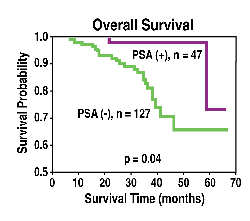
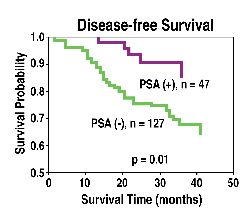
Applications The presence of PSA in tumor cytosol may be a favorable prognostic indicator for women with breast cancer.7 Women with PSA-positive tumors showed improved disease-free and overall survival over women with PSA-negative tumors. (See Figure 1.) In addition, PSA is associated with estrogen and progesterone receptor positivity, younger patient age, earlier disease stage, smaller tumor size, diploid tumors, and tumors with low S-phase function. Figure 1. Prognostic value of PSA in the overall and disease-free survival of breast cancer patients.
PSA in breast secretions was found to vary with the condition of the patient and specimen type.8 PSA at concentrations up to 300 ng/mL was present in the milk of lactating women. PSA is also present in milk from prolactinoma patients. In breast discharge fluid, levels up to 4,000 ng/mL have been detected. In nipple aspirate fluid, PSA levels as high as 2,000 ‚ 4,000 ng/mL have been found, as compared to less than 4 ng/mL in male serum. PSA levels in nipple aspirate were inversely correlated with breast cancer risk. The usefulness of prenatal PSA determinations has been explored. Elevated serum PSA has been found in pregnant women.9 PSA has also been found in amniotic fluid, where its significance is not yet understood. Molecular
Studies At the genetic level, reverse-transcription polymerase chain reaction (RT-PCR) has been used to study the expression of PSA in both tumor samples10-12 and tissue culture model systems.13,14 PSA gene sequencing has been used to determine genetic aberrations that may lead to altered expression of the PSA protein. The genetic transcript of PSA (PSA mRNA) from breast tumors shared identical sequence homology with PSA mRNA from the prostate. Levels of PSA protein produced by these tumor cells have been found to range from undetectable to very high. This varied level of protein production led to the study of the genetic basis of the expression of PSA protein. Genetic alterations were found only in regions of the PSA gene that do not code for the PSA protein but enhance its expression.10,11 PSA gene expression in cultured breast carcinoma cells was also found to be upregulated by androgens and progestins. Further study of the physiology of PSA in the breast is required to understand its significance in this tissue. Since PSA is an enzyme, it must have a natural substrate in breast tissue. The connection between PSA expression and the pathophysiology of breast cancer remains to be established. References 1. Lopez-Otin C, Diamandis EP. Breast and prostate cancer: an analysis of common epidemiological, genetic and biochemical features. Endocr Rev 1998;19:365-96. 2. Ferguson RA, Yu H, Kalyvas M, Zammit S, Diamandis EP. Ultrasensitive detection of prostate-specific antigen by a time-resolved immunofluorometric assay and the IMMULITE immunochemiluminescent third-generation assay: potential applications in prostate and breast cancers. Clin Chem 1996;42:675-84. 3. Melegos DN, Diamandis EP. Diagnostic value of molecular forms of prostate-specific antigen for female breast cancer. Clin Biochem 1996;29:193-200. 4. Borchert GH, Melegos DN, Tomlinson G, Giai M, Roagna R, Ponzone R, Sgro L, Diamandis EP. Molecular forms of prostate-specific antigen in the serum of women with benign and malignant breast diseases. Br J Cancer 1997;76:1087-94. 5. Giai M, Yu H, Roagna R, Ponzone R, Katsaros D, Levesque MA, Diamandis EP. Prostate-specific antigen in serum of women with breast cancer. Br J Cancer 1995;72:728-31. 6. Foekens JA, Diamandis EP, Yu H, Look MP, Meijer-van Gelder ME, van Putten WLJ, et al. Expression of prostate specific antigen (PSA) correlates with poor response to tamoxifen therapy in recurrent breast cancer. Br J Cancer (in press). 7. Yu H, Giai M, Diamandis EP, Katsaros D, Sutherland DJ, Levesque MA, et al. Prostate-specific antigen is a new favorable prognostic indicator for women with breast cancer. Cancer Res 1995;55:2104-10. 8. Yu H, Diamandis EP. Prostate-specific antigen in milk of lactating women. Clin Chem 1995;41:54-8. 9. Lambert-Messerlian GM, Canick JA, Melegos DN, Diamandis EP. Increased concentrations of prostate-specific antigen in maternal serum from pregnancies affected by fetal Down syndrome. Clin Chem 1998;44:205-8. 10. Tsuyuki D, Grass L, Diamandis EP. Frequent detection of mutations in the 5' flanking region of the prostate-specific antigen gene in female breast cancer. Eur J Cancer 1997;33:1851-4. 11. Schuur ER, Henderson GA, Kmetec LA, Miller JD, Lamparski HG, Henderson DR. Prostate-specific antigen expression is regulated by an upstream enhancer. J Biol Chem 1996;271:7043-51. 12. Cleutjens KB, van der Korput HA, van Eekelen CC, van Rooij HC, Faber PW, Trapman J. An androgen response element in a far upstream enhancer region is essential for high, androgen-regulated activity of the prostate-specific antigen promoter. Mol Endocrinol 1997;11:148-61. 13. Yu H, Diamandis EP, Zarghami N, Grass L. Induction of prostate specific antigen production by steroids and tamoxifen in breast cancer cell lines. Breast Cancer Res Treat 1994;32:291-300. 14. Zarghami N, Grass L, Diamandis EP. Steroid hormone regulation of prostate-specific antigen gene expression in breast cancer. Br J Cancer 1997;75(4):579-88. |
 |
|||
| Home
- Search
- Site
Map - Contact
Us About DPC - Medical Conditions - Technology - Immunoassay Products - Financial - Employment |