  |
DPC
Cosponsors 25th Anniversary Meeting of the ISOBM
DPC
was delighted to cosponsor the annual meeting of the International Society
for Oncodevelopmental Biology and Medicine (ISOBM) held this year in Montreux,
Switzerland. The society was founded in 1972 by the late Professor Hidematsu
Hirai, Sapporo, Japan, who wanted to facilitate international contact
between scientists from Japan, Russia, Europe, Canada and the US in the
field of carcinoembryonic antigens. All of the 250 submitted abstracts
were published in the society's journal, "Tumor Biologys ", and made available
during the ISOBM meeting.
Tumor
Markers in Cancer Immunotherapy
The scientific symposia covered aspects of cancer immunotherapy, tumor
targeting, gene therapy, apoptosis (programmed cell death), and cytokine
therapy. Many studies were reported on the use of tumor markers in a variety
of cancers, including prostate, breast, lung, ovarian, melanoma, germ
cell, gastrointestinal tract and pancreatic. Often, combinations of markers
are of greater value than markers used individually.
Among
studies using DPC's tumor marker assays were two by independent research
groups on the detection of serum interleukin-2 receptors (IL-2R) in benign
and malignant epithelial ovarian tumors, using the IMMULITE® IL-2R* assay.
Serum cytokine measurements hold the promise of many applications in oncology.
Tissue
Differentiation Workshops
One feature of the ISOBM meeting which has excited academic and industry
scientists alike has been the tissue differentiation (TD) workshops. The
workshops are intended to be a bridge between research and industry, wherein
monoclonal antibodies can be submitted to gain an understanding of some
tumor marker characteristics. The areas which have benefited from analyses
are prostate specific antigen (PSA), cytokeratins (for example, TPS(TM)*‚an
assay which has recently become available on the IMMULITE), sialyl-Lewisa
(GI-MA*, CA19-9) for gastrointestinal and pancreatic tumors, alpha-fetoprotein
(AFP*) and MUC1 antigen (BR-MA*, CA15-3). This year a new workshop was
announced for HCG with the intention of better understanding this molecule
and obtaining a consensus among assay manufacturers. DPC has actively
participated in, and has submitted a number of monoclonal antibodies to,
these workshops.
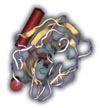 Prostate specific antigen molecular model.
Some key residues in the active site region are in red. The disulfide
bridges are in green. Strands and helices appear as yellow arrows and
magenta cylinders, respectively. (Used with permission from Dr. Bruno
Villoutreix and Dr. Hans Lilja of Lund University, Malm– University Hospital,
Sweden.)
Prostate specific antigen molecular model.
Some key residues in the active site region are in red. The disulfide
bridges are in green. Strands and helices appear as yellow arrows and
magenta cylinders, respectively. (Used with permission from Dr. Bruno
Villoutreix and Dr. Hans Lilja of Lund University, Malm– University Hospital,
Sweden.)
PSA
Workshop
The workshops categorized the antibodies according to the region of the
molecule that they recognize. For example, in the PSA workshop, all of
the monoclonal antibodies submitted have been mapped to six distinct binding
regions on the molecule by crossinhibition studies. The five PSA monoclonals
submitted by DPC were chosen in virtue of their ability to detect different
epitopes on the molecule, including the alpha1-antichymotrypsin (ACT)
binding site on PSA. The predominant form of PSA in the serum is the complex
PSA-ACT; antibodies that detect the ACT-binding site thus recognize free
PSA. One of the monoclonal antibodies submitted by DPC detects this site
and is an essential part of both the IMMULITE Free PSA assay and the Coat-A-Count®
Free PSA IRMA.
PSA
belongs to a family of proteins known as the kallikreins. The most recent
results show that 29 percent of all of the submitted PSA monoclonal antibodies
have human kallikrein 2 (hK2) reactivity; this is not totally surprising
since hK2 and PSA (hK3) have very close structural homology. The workshop
will focus next on hK2 antibodies and PSA-ACT-specific antibodies. It
will be interesting to see whether any clinical advantage can be gained
from the measurement of these other molecules. Structural studies of the
PSA molecule were presented by Dr. Hans Lilja; an example of this work
is provided in the figure. All of the data from these workshops will appear
in a future issue of "Tumor Biology ".
*Available
outside the US.
|
 |


