


|
 |
|
|||
 |
DPC Assay Plays Role in Historic Elephant Birth
The length of an elephant’s ovulatory cycle is about three months. Years of data obtained on the Indianapolis Zoo’s elephants revealed that a cycle has two LH peaks occurring, on average, 20.5 days apart. The function of the first peak is unknown, but it is the second LH peak that induces ovulation. Progesterone levels rise following these LH surges. An elevation in progesterone corresponding to the first LH peak allows staff to predict the date of ovulation, have team and equipment ready, and arrange for donor bull semen to be collected and shipped on the day of ovulation. The endocrinology lab of the Indiana University School of Medicine, Indianapolis, performed the hormonal analysis for the zoo. Suzan Hufferd and colleagues monitored Kubwa’s serum progesterone levels to detect the 3-day optimal “window” for insemination. Dr. Thomas Hildebrandt and Frank Goeritz, both of Berlin’s Zoo Biology and Wildlife Research Institute (IZW), performed the AI procedure, which had been developed by the German facility. Pregnancy was demonstrated by persistently elevated progesterone levels and by ultrasound. Progesterone testing was subsequently performed weekly with a modified overnight procedure featuring a 12.5 to 1600 pg/mL working range and calibrators prepared from stripped elephant serum. The normal period of gestation for African elephants is 20 to 22 months. Near the end of Kubwa’s pregnancy, the lab assayed samples collected every day, watching for the telltale, rapid drop in progesterone that would indicate delivery was near. The long-awaited signal came on March 1, when the morning progesterone concentration dropped by 150 pg/mL from the preceding day’s value of 300 pg/mL. By the afternoon, it had dipped to 100 pg/mL. It fell to 50 pg/mL by the next morning, and remained at that level during the following day. This precipitous drop prompted Ms. Hufferd to alert the delivery team, headed by Dr. Dennis Schmitt of Dickerson Park Zoo, Springfield, Missouri. On March 6, at 4:30 a.m., Kubwa gave birth to Amali after a short labor period lasting just an hour. Only 27 African elephants have been born in the US since the first animals were brought into the country in the 1800s. Several difficulties are inherent in captive breeding efforts: physical incompatibilities between animals, the challenges of managing the large males, the logistics of bringing a pair together from different zoos, the failure of a pair to mate, and high miscarriage and infant mortality rates. AI had already proven successful in an Asian elephant with the birth of a male calf under Dr. Schmitt’s supervision in Missouri last November—the first time ever in elephants of either species. Now, the success of AI in an African elephant raises hopes for maintaining a captive population of these animals with greater ease and certainty. Kubwa’s herd mate Ivory has also been artificially inseminated and is expected to give birth in August. The knowledge gained by this experience with captive African elephants may prove increasingly important as pressures on wild herds reduce numbers and threaten genetic diversity.
|
|||
| Home
- Search
- Site
Map - Contact
Us About DPC - Medical Conditions - Technology - Immunoassay Products - Financial - Employment |


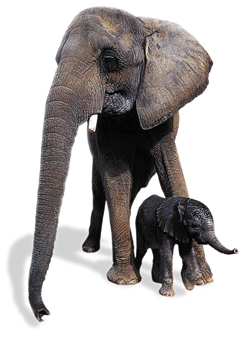 Amali,
the world’s first African elephant conceived by artificial insemination
(AI), was born to 24-year-old mother Kubwa at the Indianapolis Zoo on
March 6. The birth of the 201-pound female calf sent waves of excitement
through the zoological and conservation communities. DPC’s Coat-A-Count®
Progesterone assay provided results that assisted with the timing of the
AI procedure, helped confirm the ensuing pregnancy, and signaled the imminence
of the calf’s birth.
Amali,
the world’s first African elephant conceived by artificial insemination
(AI), was born to 24-year-old mother Kubwa at the Indianapolis Zoo on
March 6. The birth of the 201-pound female calf sent waves of excitement
through the zoological and conservation communities. DPC’s Coat-A-Count®
Progesterone assay provided results that assisted with the timing of the
AI procedure, helped confirm the ensuing pregnancy, and signaled the imminence
of the calf’s birth. 