 |
 |
| The
IMMULITE 2000 reagent wedge carousel. Customizable allergen wedges
(green) hold six allergens, allowing up to 138 allergens to reside
on board. Allergen-specific IgE testing can be performed alongside
other immunoassays (white wedges). |
IMMULITE® 2000 Allergy, DPC’s revolution in allergy testing, is now available
worldwide. IMMULITE 2000 Allergy allows consolidation of allergy testing
and other routine immunoassays onto a single platform, performs automated
allergen distribution, and offers the security of positive identification
of allergens.
The
official release began
with a special celebration
in Strasbourg, France on September 17. The
international launch, organized in the parliamentary hub of the European
Union, drew customers from more than 20 countries. The attendees learned
about the unique features and benefits of DPC’s innovative allergy testing
method, which combines DPC’s well-established liquid-allergen format with
a technological breakthrough in allergy testing automation. Presentations
by participating investigators provided an overview of the results of
analytical and clinical evaluations performed in European and American
laboratories.
An
international program of evaluation
Last spring and summer, DPC organized an extensive, multisite evaluation
program of IMMULITE 2000 Allergy involving laboratories in Germany, The
Netherlands, Norway, Portugal, Spain and the United States. The objective
of the evaluation was to assess the following:
| • |
Correlation
with defined clinical cases. Specific IgE measurements are among
the tools physicians may perform, along with anamnesis and skin-prick
tests, for allergy diagnosis. By working closely with clinical departments,
laboratories were able to determine the efficiency of IMMULITE 2000
Allergy reagents by comparison against well-documented clinical cases
for major allergens. |
| • |
Comparison
with other in vitro methods. IMMULITE 2000 Allergy results were
compared to those obtained by DPC's AlaSTAT® Microplate
(now discontinued) and other commercially available in vitro methods.
Results showed good agreement. |
| • |
Integration
in laboratories, and impact on workflow analysis. Thanks to its
random access capability, IMMULITE 2000 Allergy allows laboratories
to perform allergy testing along with any other assay on its current
menu of immunoassays. Participating laboratories were able to estimate,
under actual laboratory conditions, the benefits of this solution
compared to conventional systems dedicated to allergy alone. |
DPC
is grateful for the diligence and professionalism of the investigators
involved in generating the evaluation data. It is their experience and
feedback that DPC wished to share with future users by hosting the international
launch in Strasbourg.
Excellent
correlation with clinical cases
Two European speakers gave presentations, the results of which are discussed
below. (Complete presentations are available on request from your local
DPC representative.)
Dr.
Almeida of the Hospital Dona Estefânia’s Immunoallergy Department, headed
by Dr. Rosa Pinto, presented the results of the clinical trial performed
in Portugal. This site reviewed the performance of several major allergens
(D1, D2, E1, F2, G3, G6, M6, T9, W19) and compared IMMULITE 2000 to skin-prick
testing on nearly 750 results from 194 clinically documented allergic
patients. Overall, IMMULITE 2000 demonstrated a relative specificity of
100% and a relative sensitivity of 90.3%.
Prof.
Ring and Prof. Ollert of the Department of Dermatology and Allergy, Technical
University of Munich, agreed to study some of the major allergens found
in their country, namely D1, D2, E1, F4, G3, G6, I1, I3, T3 and W6. During
his evaluation of IMMULITE 2000 Allergy, Prof. Ollert tested 182 patients
and generated more than 1,100 results.
During
the Strasbourg meeting, Prof. Ollert presented the results of two studies
comparing IMMULITE 2000 to clinical cases. In a study involving 106 seasonal
rhinitis/asthma cases, IMMULITE 2000 demonstrated a relative sensitivity
of 97% and a relative specificity of 92%, based on testing G3, G6, T3
and W6. In another study involving 74 perennial rhinitis/asthma cases,
IMMULITE 2000 demonstrated a relative sensitivity of 93% and a relative
specificity of 100%, based on testing D1, D2 and E1.
From
findings such as these, investigators concluded that IMMULITE 2000 Allergy
provided excellent results compared to other diagnostic methods such as
skin-prick tests. Agreement with clinical cases was also very good. Thus,
IMMULITE 2000 Allergy was found to be a very reliable tool for laboratories
performing in vitro allergy diagnosis.
Good
agreement with other in vitro methods
IMMULITE 2000 Allergy is a unique combination of chemiluminescence and
liquid allergen technology. This synergy confers on the system high sensitivity
without any loss of specificity, a fact to which the clinical evaluations
and method comparisons attest.
Dr.
Almeida performed comparisons with other in vitro methods and obtained
very good agreement. For example, in a comparison against Pharmacia’s
UniCAP™ on samples from patients allergic to Dermatophagoides pteronyssinus
(D1), IMMULITE 2000 demonstrated a relative specificity of 94% and a relative
sensitivity of 99%, with a total agreement of 98%. Discrepancies were
reviewed by analysis against clinical cases and AlaBLOT* testing. Prof.
Ollert conducted a comparison against UniCAP on samples from patients
allergic to birch pollen (T3). IMMULITE 2000 demonstrated a relative specificity
of 89% and a relative sensitivity of 94%, with a total agreement of 91%.
Results
generated internally by DPC in a comparison with AlaSTAT Microplate (now
discontinued) appear in Table 1 and also demonstrate excellent agreement.
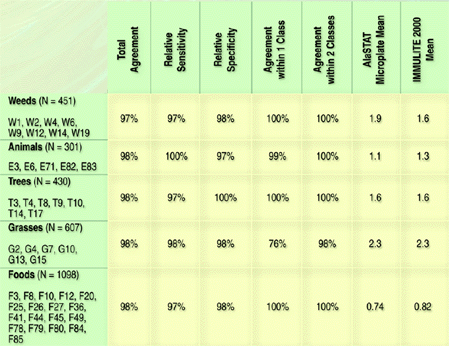 |
| Table
1. Results generated by DPC in a comparison of IMMULITE 2000 vs. AlaSTAT
Microplate on major allergens. |
Integration
of IMMULITE 2000 Allergy in the laboratory
Different types of laboratories, from specialized facilities in hospitals
to large private reference laboratories, participated in the evaluation
of IMMULITE 2000 Allergy. This diversity allowed confirmation of the ease
of use of IMMULITE 2000 Allergy in various settings: on IMMULITE 2000
instruments used for a variety of other immunoassays as well, and on instruments
dedicated solely to allergy testing. All investigators acknowledged an
improvement in the laboratory dynamics of their allergy testing.
DPC
and allergy: the ultimate solution for your laboratory
With IMMULITE 2000 Allergy, DPC now offers a unique solution for specific
IgE measurements. The fully automated, random access, walk-away system
allows specific IgE testing to be performed alongside other IMMULITE 2000
assays on board, in the same manner. The IMMULITE 2000 menu includes more
than 360 specific allergens and allergy panels, as well as AlaTOP Allergy
Screen and Total IgE, with many more allergen-specific IgE assays to follow
in the coming months.
* Sold as analyte-specific
reagents in the US
|


