|
|
|
 |
|||||
|
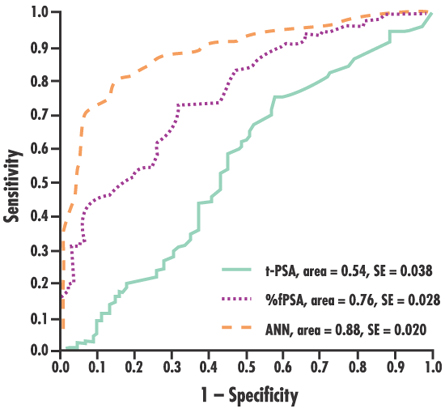
Prostate cancer screening using serum PSA and a digital rectal examination make it possible to detect disease early when treatments are more likely to be successful. However, the conventional PSA threshold value of 4.0 µg/L has been questioned, since 20 to 50 percent of clinically significant organ-confined prostate tumors occur in men with a total serum PSA of less than 4 µg/L.1 Although use of the free-to-total PSA ratio ("PSA index") clearly improves specificity by approximately 15 to 20 percent compared to total PSA alone, its overall specificity is only 20 percent in men with PSA levels of less than 4.0 µg/L. To improve the accuracy of prostate cancer detection, and to exclude unnecessary biopsies in men free of cancer, different logistic regression models and artificial neural networks (ANNs) have been introduced. An ANN is an information-processing paradigm that organizes information in much the same way as the mammalian brain. ANNs have been shown to predict the outcome of prostate biopsy in individual patients better than traditional statistics and can handle a greater number of variables with nonlinear relations than logistic regression. Dr. Carsten Stephan, from the Department of Urology, University Hospital Charité, Humboldt University, Berlin, Germany, tested an ANN in an attempt to improve the accuracy of prostate cancer detection. Input variables included the ratio of free PSA and total PSA values, patient age, prostate volume and digital rectal examination findings (Figure 1). For the training and validation of this ANN (called "ProstaClass"), six institutions in Germany, The Netherlands and Canada contributed data on nearly 1,200 patients with biopsy-proven prostate cancer or benign findings. Results of this study, published last year in Clinical Chemistry, showed ProstaClass to be significantly more sensitive than either total PSA or percent free PSA in clinical practice (p < 0.01).2 Overall, Dr. Stephan was able to improve the sensitivity to detect prostate cancer by 20 to 22 percent over that obtained with the free-to-total PSA ratio alone. Most importantly, in men with low PSA levels (between 2.0 and 4.0 µg/L), the ANN detected 72 percent and 65 percent of cancers with specificities of 90 percent and 95 percent, respectively. Figure 2 depicts a ROC curve comparing total PSA, free-to-total PSA ratio and ProstaClass for patients with a PSA value in the 4.1 to 10 µg/L range, and clearly shows superior sensitivity for ProstaClass. Since only DPC assays were used to train and validate ProstaClass, the sensitivity of this ANN could well be significantly lower if other manufacturers' PSA assays are used.
Readers outside the US who would like to obtain the ProstaClass software may contact their DPC national distributor, or download the software directly from the Hospital Charité Web site (www.charite.de/ch/uro/) by clicking on Sitemap, then on Prostatabiopsie, and finally right-clicking on either ProClass.zip or ProClass.exe and saving the file to disk. Any readers interested in a reprint of the Clinical Chemistry article on the ProstaClass software validation study may contact their local DPC representative. *IMMULITE® Free PSA is available outside the US. References 2. Stephan C, Cammann H, Semjonow A, Diamandis EP, Wymenga LF, Lein M, et al. Multicenter evaluation of an artificial neural network to increase the prostate cancer detection rate and reduce unnecessary biopsies. Clin Chem 2002;48:1279-87. |
||||||
 |
||||||
| Home
- Search
- Site
Map - Contact
Us About DPC - Medical Conditions - Technology - Immunoassay Products - Financial - Employment |