| |
Matrix
Effect Of PEG Precipitation In Detection Of Macroprolactin
In IMMULITE®
AND IMMULITE® 2000
Prolactin Assays
Abstract
| There
have been several publications regarding the use of a PEG precipitation
procedure to identify macroprolactin in patient samples with the IMMULITE®
and IMMULITE® 2000 prolactin assays. We evaluated PEG precipitation
(1 vol serum + 1 vol 25% PEG 8000 solution in normal saline) in both
IMMULITE and IMMULITE 2000 assays and found that the matrix effect
introduced by this procedure cannot be ignored. The results for both
assays are similar. In IMMULITE and IMMULITE 2000 prolactin assays,
for control materials, random samples and pregnancy samples that do
not contain macroprolactin, recovery of prolactin after PEG precipitation
is significantly higher than expected, ranging from
120% to 190%. However, measurements using
calibrators that were were
treated by the same procedure showed good recovery for these samples
(100% ± 10%, mean ± SD). |
Scientific
Poster
Presented at the 2002 AACC Orlando, Florida
|
| Poster
No. B-75 |
Li
W1,
Sustarsic D1,
Fahie-Wilson M2,
Vankrieken L1,
Walker K1,
Del Rosario I1,
El Shami AS1 |
1.
Diagnostic Products Corp., Los Angeles, CA, US;
2. Department of Clinical Chemistry, Southend Hospital, Westcliff-on-Sea,
UK |
| |
We
also performed studies on 40 samples that have been shown to contain macroprolactin
by gel filtration or PEG procedures in the Delfia prolactin assay. Based
on measurements with treated calibrators, the recoveries on these samples
after PEG precipitation ranged from 6 to 67% (mean = 34%). For all samples
(with or without macroprolactin) after PEG precipitation, when the prolactin
values that were derived from the original calibration curve (Y) were
compared to the values derived from the curve with treated calibrators
(X), a linear relationship was found: Y = 1.38X + 0.31 ng/mL, r2
= 0.9999. We conclude that in order to use a PEG precipitation procedure
for evaluation of macroprolactin in patient samples, matrix effects should
be taken into consideration, especially if there is an interest in defining
the concentration of active prolactin in the macroprolactin samples.
Introduction
Macroprolactin is one of the multiple forms of prolactin in vivo. It is
characterized as high molecular weight complexes of prolactin and IgG.
Although it has little or no bioactivity, macroprolactin can be recognized
in immunoassays with varied crossreactivities depending on the samples
or the method used (John et al., 2000; Fahie-Wilson, 2000). This crossreactivity,
combined with the fact that macroprolactin also has a longer half-life
in vivo, may result in a false impression of hyperprolactinemia that could
lead to diagnostic confusion or inappropriate patient treatment. It was
reported that macroprolactin was the cause of 16 percent of the hyperprolactinemia
results measured by the Roche Elecsys assay (Fahie-Wilson et al., 2000).
A number of procedures have been described for identification of the presence
of macroprolactin including gel-filtration chromatography and PEG precipitation.
Because it is difficult to routinely perform gel-filtration chromatography,
PEG precipitation has become the favored method.
Materials
and Methods
IMMULITE and IMMULITE 2000. The IMMULITE is a random-access, solid-phase
immunoassay analyzer that employs chemiluminescent enzyme detection and
an efficient centrifugal wash. The IMMULITE 2000 employs an equivalent
technology with additional features for higher volume immunoassay processing.
(Diagnostic Products Corp., Los Angeles, CA.)
PEG
precipitation. One volume of 25% polyethylene glycol (PEG) 8000 (Sigma,
St. Louis, MO) solution in normal saline was mixed with 1 volume of patient
sera, controls, adjustors, or calibrators. The mixture was allowed to
stand at room temperature for 10 minutes, and then centrifuged at 3,000
x g for 15 minutes. Supernatants and untreated samples were assayed
for prolactin with IMMULITE or IMMULITE 2000 automated chemiluminescent
immunoassays. A precipitation method using PEG 6000 was also performed
on samples assayed with the Delfia fluoroimmunoassay (Auto Delfia, Wallac,
UK).
Gel
filtration. Gel-filtration chromatography was performed on Sephacryl
S-300 (Pharmacia, Peapack, NJ). Macroprolactin was identified as a peak
of immunoreactive prolactin eluting between IgA and IgG. If macroprolactin
was detected, all fractions were analyzed to confirm the presence of two
peaks of prolactin immunoreactivity, and macroprolactin was quantitated
from the peak area by fluoro-immunoassay (Auto Delfia, Wallac, UK).
Results
Prolactin recovery after PEG precipitation
125I-labeled monomeric prolactin tracer
(25 µL) was added to (475 µL) each of 10 sera (475 µL) with no apparent
macroprolactin. Next, either PEG diluent (saline control) or PEG solution
was added. After precipitation, each supernatant (410 µL) was counted.
Mean recovery was about 88% of values prior to precipitation.
Human
IgG recovery after PEG precipitation
125I-labeled human IgG tracer (60 µL) was added
to each of 10 sera (1140 µL). Next, either PEG diluent (saline control)
or PEG solution was added. After precipitation, each supernatant (400
µL) was counted. An average of 7% of added counts remained in the supernatants,
indicating that 93% of the IgG was precipitated by the PEG procedure.
The
results that follow are for the IMMULITE system. Similar results were
obtained for the IMMULITE 2000 system. (Data not shown.)
Matrix
Effect of PEG Precipitation on IMMULITE Assay
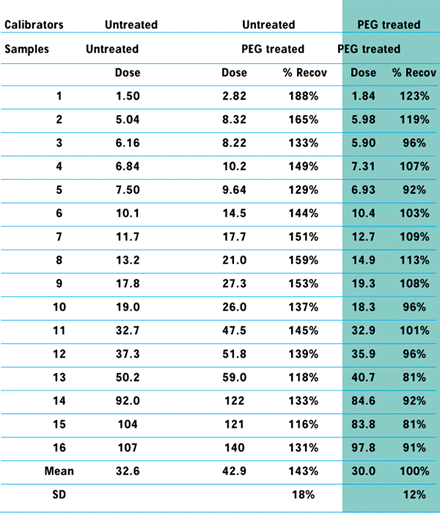
Random patient sera and controls (n = 16) with and without PEG precipitation
were analyzed by the IMMULITE Prolactin assay. After correction for a
dilution factor of 2, recoveries for the PEG-treated samples were calculated.
An apparent over-recovery of 116 to 188% (143% ± 18%, mean ± SD) was observed.
Calibrators included in the run were also treated by the same PEG procedure.
All measurements were recalculated using the calibration curve that was
generated from the PEG-treated calibrators, and a satisfactory recovery
(100% ± 12%, mean ± SD) was obtained. This difference in values for samples
with and without PEG treatment clearly demonstrated a matrix effect. Good
recovery could be obtained when both calibrators and samples were treated
by the same procedure (Table 1).
|
|
| Table
1. Over-recovery of monomeric prolactin by the IMMULITE assay after
PEG precipitation, and correction using PEG-treated calibrators. |
PEG
precipitation was also performed on 40 additional samples containing macroprolactin.
For all samples after PEG precipitation, IMMULITE prolactin values derived
from the original calibration curve (Y) and from the "treated" curve (X)
demonstrated a linear relationship (Figure 1).
 |
| Figure
1. Comparison of IMMULITE Prolactin values after PEG precipitation,
based on PEG-treated and untreated calibrators. |
| Y
= 1.38X + 0.31 ng/mL r2 = 0.9999 |
| Y
= 1.38X + 0.31 ng/mL n
= 56 |
Macroprolactin
recovery by IMMULITE after PEG precipitation
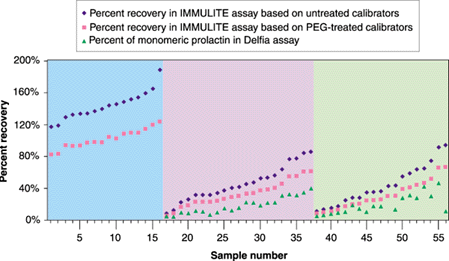
We studied the 40 samples that had been shown to contain macroprolactin
by PEG precipitation, gel-filtration chromatography or protein G chromatography
in the Delfia prolactin assay. Prolactin levels by the IMMULITE Prolactin
assay without PEG treatment were 12 to 120 ng/mL, with a mean of 42 ng/mL.
Recoveries after PEG precipitation ranged from 8 to 95% (45% ± 24%, mean
± SD) by IMMULITE. Recoveries on these samples after PEG precipitation,
based on treated calibrators, ranged from 6 to 67% (34% ± 17%, mean ±
SD). (See Figure 2.) For normal samples that are not expected to contain
macroprolactin (1 – 16), no data on the Delfia prolactin assay are
available. For the macroprolactin samples (17 – 56), the percentage
of monomeric prolactin was estimated in the Delfia prolactin assay by
PEG precipitation for samples 17 – 37, and by gel-filtration chromatography
for samples 38 – 56. Samples 47 – 56 were examined for the presence
of IgG in the macroprolactin by affinity chromatography with protein G:
a major component was detected in all samples except sample 53.
|
|
| Figure
2. Percent recovery of prolactin with PEG procedure. Samples are grouped
according to the method used to estimate the percentage of monomeric
prolactin by the Delfia prolactin assay. (See text for details.) |
Conclusion
and Discussion
We have shown that the PEG procedure used in this study allows an 88%
recovery of monomeric prolactin as verified by the 125I
labeling method. The efficiency of the procedure for precipitation of
human IgG is about 93%, as verified also by the 125I
labeling method. Essentially, the PEG procedure allows satisfactory recovery
of monomeric prolactin and effective precipitation of human IgG molecules.
The
PEG procedure allows effective identification of samples with and without
macroprolactin in IMMULITE and IMMULITE 2000 prolactin assays. However,
a matrix effect cannot be disregarded, because it causes a significant
over-recovery if not corrected for by using calibrators treated with the
same PEG procedure. To use a PEG precipitation procedure for evaluation
of macroprolactin in patient samples, matrix effects should be taken into
consideration, especially if there is an interest in defining the concentration
of active prolactin in the macroprolactin samples.
References
1. John R, et al. Clin Chem 2000;46:884-5.
2. Fahie-Wilson MN. Clin Chem 2000;46:2022-3.
3. Fahie-Wilson MN, et al. Clin Chem 2000;46:1993-5.
4. Gibson G, et al. Clin Chem 2001;47:331-3.
5. Urgell, et al. [poster PO-L017]. Clin Chem Lab Med 2001;39(Suppl):S244.
6. Berlitz, et al. [poster PO-L002]. Clin Chem Lab Med 2001;39(Suppl):S240.
|