|
|
|
|||||||||||||||||||||||||||
  |
Real
Benefits with 3gAllergy™ The future is now:
DPC's 3gAllergy, the only third-generation allergy assay The first generation
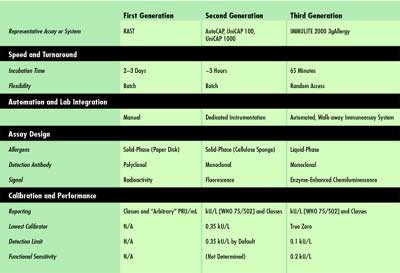
RAST methodology offers diagnostic values of serum allergen-specific IgE similar to those of the skin prick test (SPT), but RAST demonstrates much higher reproducibility and is the test of choice with patients suffering from severe urticaria and eczema. Another noticeable clinical advantage of RAST concerns patients prone to anaphylactic reactions with exposure to even minute amounts of allergen. In addition, the diagnostic values of RAST are not affected by pharmacotherapy administered for allergy symptoms. RAST became an established laboratory tool to assist in allergy diagnostics on the basis of its clinical features, dependable results, and the convenience it offers patients. In Europe, allergy specialists were receptive to the first-generation RAST methodology. The second generation
The advent of the second-generation in vitro allergy test, also known as modified RAST (mRAST), turned the second-generation in vitro allergy test into a mainstream assay. On account of several unrelated issues, allergy specialists refrained from fully endorsing RAST and mRAST in the US. The key determining factor for taking this stance was that SPT was deemed to be more sensitive than RAST and mRAST. Owing to the alarming growth of allergy in the US, however (where approximately 50 million Americans suffer from allergy-related symptoms), and since the cost for allergy was approaching $20 billion per year, the American healthcare system favorably incorporated the first- and second-generation assays into its formulary. Still, the needs of laboratories were not being adequately met. Extrinsic pressures on laboratories mandated substantial improvements to first- and second-generation methodologies for in vitro allergy testing. Economic forces dictated radical changes to improve assay performance and to develop an instrument capable of justifying its cost by addressing the day-to-day expectations of laboratory managers and fulfilling the demands of business managers. The
third generation
The prevalence of allergic disease and the drastic changes in the US healthcare paradigm require that primary care physicians, pediatricians and other medical specialists manage and treat patients with allergies. The ongoing changes in the healthcare system have created a stronger diagnostic role for laboratories. Early on, DPC recognized the global healthcare market's need for a new in vitro allergy assay and an automated system. During the first DPC International Conference on Allergy, held in June, 2003 in Paris, France, Michael Ziering, President and CEO, announced DPC's commitment to dedicate appropriate resources to allergy diagnostics over the coming years and to provide the most advanced methodology to laboratories, along with the necessary educational programs and support. 3gAllergy has enabled DPC to meet the needs of laboratories of any size. From a simple serum sample, laboratories are able to generate fast and accurate test results that provide physicians with valuable clinical information. DPC's unique liquid allergens contribute greatly to 3gAllergy's sensitivity, specificity and reliability. The soluble polymer/copolymer support for the allergens increases the accessibility of binding sites and their accessibility to allergen-specific IgE antibodies. DPC's proprietary wash technique maximizes the removal of excess reagent and ensures adequate separation of bound from unbound materials. The enzyme-enhanced chemiluminescence technology allows for greater accuracy and precision compared to other signal detection methods. A zero calibrator ensures a true 0.1 kU/L detection limit. 3gAllergy's calibrators are standardized against the WHO 2nd International Reference Preparation (IRP) 75/502. Assay results are reported quantitatively as well as in standard and extended class scores. Today's solution
As the unique features and benefits of DPC's third-generation methodology have fulfilled the expectations of laboratories, it is essential to create awareness among physicians. First- and second-generation in vitro allergy tests have demonstrated their usefulness as laboratory diagnostic tests to physicians. Numerous studies have concluded the clinical utility of in vitro allergen-specific IgE tests. 3gAllergy can assist physicians in identifying allergens responsible for evoking allergy symptoms, predicting future allergy development, and guiding clinical management and treatment of allergy patients. Its functional sensitivity of 0.2 kU/L allows for the detection of existing allergies in infants and can help predict the future risk of developing allergy-induced diseases such as asthma1. It also facilitates timely therapeutic intervention. DPC is determined to cooperate on a worldwide basis with key research centers and opinion leaders to evaluate the clinical significance of third-generation criteria, and share its findings with healthcare providers for the ultimate benefit of patients.
|
|||||||||||||||||||||||||||
| Home
- Search
- Site
Map - Contact
Us About DPC - Medical Conditions - Technology - Immunoassay Products - Financial - Employment |