|
|
|
|||||||||
  |
DPC's Focus On Allergy The prevalence of allergic disease is increasing throughout the world, particularly among young children.1 Ongoing study of this disorder has led to the understanding that food allergy symptoms in the early stages of life (eczema, for example) typically evolve into more severe forms of allergic disease (such as asthma) in late childhood. Therefore, it is now widely accepted that early diagnosis is critical for successful treatment. While patient and general physician education is essential for establishing early diagnosis and appropriate treatment strategies, laboratories also play an important diagnostic role through in vitro testing, which provides valuable clinical information. DPC has a long history in the field of in vitro allergy diagnostics, from the development of its first allergy assay in 1988 to the release of allergen-specific IgE testing on the IMMULITE® 2000 in September 2001. The Company's long-term commitment to allergy diagnostics was emphasized by Michael Ziering (CEO, DPC) during his opening remarks at DPC's first International Conference on Allergy (Paris, June 2003). Mr. Ziering stated that allergy diagnostics will remain a priority for the Company over the coming years, and that the Company's major objectives will be to provide state-of- the-art solutions to laboratories and unique educational programs and tools to support allergy testing. DPC's International Conference on Allergy Held in Paris just before the 22nd Congress of the EAACI (European Academy of Allergology and Clinical Immunology), where DPC exhibits each year, DPC's first International Conference on Allergy was attended by 280 representatives of 25 countries. The program offered a unique opportunity to discuss the current status of in vitro allergy testing from both laboratory and clinical points of view. Prof. M. Ollert and Dr. M. Almeida, two well-recognized European allergy specialists, chaired the conference, and speakers from throughout Europe were invited to give presentations. In general, their topics addressed the following questions:
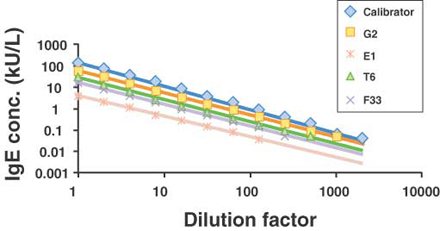
The laboratory perspective Until fairly recently, the trend toward laboratory automation and consolidation excluded in vitro allergy testing. The lack of any fully automated alternative to manual allergen processing meant that allergen-specific IgE testing remained time consuming and labor intensive. The release of allergy testing on the IMMULITE 2000—a mere two years ago—has changed the testing paradigm in laboratories throughout the world. Now allergy testing is available to every laboratory, since it can be performed just like any other immunoassay in a random access mode. Today, more than 400 laboratory managers in Europe have adopted allergy testing on the IMMULITE 2000. Three of these laboratory managers, each from a different country and in charge of different types of laboratories, were among the speakers at the conference. Their presentations included discussions on how allergy testing on the IMMULITE 2000 has improved the organization of their laboratories. Benefits of integrating allergy testing on IMMULITE 2000 In a French reference laboratory Dr. Laurence Guilloux heads the Immunoallergy Department of LAM Mérieux, a large reference laboratory (Lyon, France). Her department performs 700 to 900 specific-IgE assays daily. In 2002, the laboratory sought to improve its workflow, consolidate instruments and decrease labor costs for allergy testing. At the time of the evaluation, she had eight technicians on staff, and the allergy testing instruments in the laboratory included eight AutoCAP™ systems, two UniCAP® instruments, a Tecan for sample pipetting, a "positioning guide" for ImmunoCAP® distribution and a gamma counter. She was able to achieve her objectives after validating the most routinely run allergens and transferring them onto the IMMULITE 2000. These routine allergens account for 70 percent of their total inhalant allergen requests (28 inhalant allergens, including mites, house dust, latex, tree/weed/grass pollens, venoms, molds and animal dander/epithelium). The laboratory has noted a substantial reduction in instrumentation and hands-on time. In addition, because of the short time-to-first-result and high throughput, the laboratory can now perform two runs per day. In an Irish hospital immunology laboratory Dr. Alistair Crockard heads the Regional Immunology Service of the Royal Victoria Hospital (Belfast, Northern Ireland). Like Dr. Guilloux, he was a confirmed Pharmacia user for more than 20 years until he switched to allergy on IMMULITE 2000. Previously, he had been very satisfied with the laboratory's four UniCAP systems, but the laboratory needed to increase its productivity and streamline workflow, which required a system with complete random access automation and proven reliability. The laboratory's new system was the first IMMULITE 2000 placement in Ireland. The initial data obtained through an activity-based costing program are very encouraging and have already demonstrated an increase in productivity. In a private German laboratory Dr. Michael Müller is an associate director of a privately owned laboratory (Hamburg, Germany). Before installing allergy on IMMULITE 2000, he was using two different platforms: a Centaur® (Bayer) for total IgE and two CAP systems for specific IgE testing. By integrating allergy testing on the IMMULITE 2000 in his laboratory, Dr. Müller sought the following objectives: 1) to fully automate 85 percent of all requests for total and specific IgE, 2) to consolidate workstations by reducing the number of instruments, and 3) to decrease hands-on time for personnel. The laboratory consolidated more than 95 percent of its allergy testing (allergens with more than 20 requests per year) and considerably reduced hands-on time. The system's continuous random access capability provides physicians with same-day results. Many other DPC customers have reported similar improvements in their workflow as a result of installing allergy testing on the IMMULITE 2000 in their laboratories. Data supporting such reports were presented during the conference in scientific posters from Spain and the UK. Analytical performance evaluations Dr. Debra Burns (DPC, Los Angeles) presented results from the evaluation study she conducted. This protocol was designed according to the NCCLS I/LA20-A guideline for allergen-specific IgE assays-an authoritative evaluation protocol. As Dr. Burns reported, the IMMULITE 2000 results met all the targets specified in the guideline.2 These results were supported by similar data obtained from other analytical validations conducted externally. Dr. Guilloux, for example, evaluated the assay performance following the NCCLS guideline and concluded that allergy testing on the IMMULITE 2000 offers "good reproducibility, binding capacity and specificity." In addition, she compared allergy results on the IMMULITE 2000 with those of the Pharmacia CAP System and observed that the two systems demonstrated good agreement. Dr. Crockard and Dr. Müller likewise reported good analytical performance of the IMMULITE 2000, including excellent precision and linearity, as well as close correlation of results with those of their former methods (UniCAP and CAP, respectively). Among its many exceptional features, the IMMULITE 2000 allergy system offers analytical and functional sensitivities of 0.1 and 0.2 kU/L. In this regard, it is superior to conventional "second generation"* assays, which are limited to reporting values at or above 0.35 kU/L.3 The IMMULITE 2000 assay also exhibits a much broader range of dilutional linearity, extending down to 0.1 kU/L (Figures 1 and 2). This new DPC method has essentially defined itself as the first and only "third generation" assay for measuring specific IgE, with respect to its analytical performance, complete random access automation and other distinctive characteristics.6 The final presentation, given by Dr. Robert Oosterom, was a perfect follow-up to that of Dr. Burns. He reported on his involvement with an external quality control program that took place in The Netherlands in 2002. The program included 22 participating laboratories that conducted allergy testing on the IMMULITE 2000. He established a precision profile based on the results, demonstrating the system's interlaboratory precision, which was consistent with data exhibited in the previous presentations.
The clinical perspective Dr. Sara Prates routinely orders in vitro allergy tests in her practice at the Immunoallergy Department of Dona Estefânia Hospital (Lisbon, Portugal). Working in a pediatric facility, she takes a special interest in food allergy, particularly that associated with cow's milk, the most frequently occurring food allergy in Portugal. Currently, the diagnosis of cow's milk allergy (CMA) is based on clinical history, skin prick tests (SPT), and dietary avoidance followed by a food challenge test. SPT is highly sensitive, but has a limited positive predictive value. The food challenge test has a number of disadvantages, owing to the risk of life-threatening reactions, its time-consuming nature, and the potential for delaying food tolerance. Consequently, she has turned to in vitro testing in an effort to improve identification of patients with CMA, predict their tolerance levels and decrease the need for dangerous food challenge tests. The Immunoallergy Department was using UniCAP prior to the installation of allergy testing on the IMMULITE 2000. Clinical performance for the milk allergen was then evaluated on the new platform. Fifty children (31 pediatric patients with IgE-mediated CMA, manifesting immediate-type symptoms; and 19 "unhealthy" children with atopic dermatitis and other allergic symptoms but no CMA) were included in the evaluation. The investigators concluded that the two in vitro methods offered comparable performance. During the conference poster session, several posters from Spain, Italy, Portugal and Denmark demonstrated similar clinical performance for allergy testing on the IMMULITE 2000. Conclusion The first DPC International Conference on Allergy demonstrated that allergen-specific IgE testing on the IMMULITE 2000 can be easily integrated into any type of laboratory that performs immunoassay testing. The IMMULITE 2000 effectively improves laboratory workflow either when used as an instrument dedicated to allergy or when used to perform allergy testing in combination with other immunoassays. The system features state-of-the-art analytical performance due, in part, to its use of enzyme-enhanced chemiluminescence and liquid allergens. Its exemplary analytical and functional sensitivity (0.1 and 0.2 kU/L, respectively), which have been validated both internally and externally using NCCLS guidelines, as well as its random access capability, have placed this system in a league of its own-the first, and currently the only, third generation method for measuring allergen-specific IgE. Developing strong partnerships with allergy specialists and existing or potential users through meetings like the DPC International Conference on Allergy will remain a primary focus for the Company. These educational events encourage open discussion and provide a forum for the sharing of ideas, which improves the dissemination of industry knowledge and frequently leads to product enhancements and the development of new assays. Summaries of all presentations from the conference, including reformatted versions of the 21 posters displayed during the event, are available in a booklet entitled "International Allergy Conference Proceedings" (document number ZB214-A). The booklet may be obtained through your DPC representative. *The "generational" characterization of allergen-specific IgE assays is widespread in the literature. See, for example, Plebani et al.4 and Hamilton et al.5 References 2. Tse S, Chuang T, Li TM, Hovanec-Burns D, El Shami AS. Analytical performance evaluation of the allergen-specific IgE assays on the IMMULITE® 2000 system. Allergy 2003: 58 (Suppl 74):364. 3. Yunginger JW, Ahlstedt S, Eggleston PA, Homburger HA, Nelson HS, Ownby DR, Platts-Mills TA, Sampson HA, Sicherer SH, Weinstein AM, Williams PB, Wood RA, Zeiger RS. Quantitative IgE antibody assays in allergic diseases. J Allergy Clin Immunol. 2000 Jun;105(6 Pt 1):1077-84. 4. Plebani M, Bernardi D, Basso D, Borghesan F, Faggian D. Measurement of specific immunoglobulin E: intermethod comparison and standardization. Clin Chem. 1998 Sep;44(9):1974-9. 5. Hamilton RG, Adkinson NF Jr. Clinical laboratory assessment of IgE-dependent hypersensitivity. J Allergy Clin Immunol. 2003 Feb;111(2 Suppl):S687-701. 6. Li TM, Chuang T, Tse S, Hovanec-Burns D, El Shami AS. Development of a third generation allergen-specific IgE assay on the continuous random access IMMULITE® 2000 analyzer. Clin Chem 2003;49(S6):A20.
|
|||||||||
| Home
- Search
- Site
Map - Contact
Us About DPC - Medical Conditions - Technology - Immunoassay Products - Financial - Employment |