|
|
|
 |
|||||
|
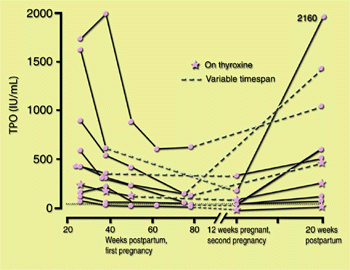
Q: What is the prevalence of PPTD? A: PPTD, defined by biochemical criteria, has a relatively high prevalence of 5 to 9 percent in the year after parturition. The prevalence is much higher in women with existing autoimmune diseases, notably type 1 diabetes mellitus. Q: What is the immediate clinical significance of PPTD to the mother and future offspring? A: Although in the majority of cases PPTD is an autoimmune, benign and self-limiting disorder, at least 25 percent of women with biochemical evidence of hypothyroidism will benefit from thyroid replacement therapy. Higher rates of fertility problems and miscarriage are observed among those who remain untreated, as many of these women have subclinical hypothyroidism and test positive for TPOAb. A growing and disconcerting body of evidence suggests that if the seemingly mild thyroid function abnormalities present in PPTD persist into a subsequent pregnancy, they may be linked to impairment of the intellectual development of the child born from that pregnancy. Q: What is the mother's risk of developing permanent thyroid dysfunction? A: A number of longitudinal studies have reported that the annual rate of progression to permanent hypothyroidism is 2.6 to 11.8 percent (mean: approximately 6.4 percent). This is a very high rate compared to a total incidence rate in adult women of 0.41 percent (i.e. 4.1 cases/1,000 survivors/year) from the data of the Whickham population study.1 Therefore, women with the hypothyroid form of PPTD are at a much greater risk of early progression to permanent hypothyroidism compared to women in the general population. Q: What are the best predictors of a mother's risk of developing permanent thyroid dysfunction? A: In the Whickham population study, there was a gradient of increased probability of hypothyroidism developing within 20 years if the initial TSH was greater than 2.0 mIU/L. This probability is significantly increased if the woman is thyroid autoantibody positive and, conversely, is markedly decreased if the woman is thyroid autoantibody negative. Unfortunately, equivalent long-term data are not available for women with PPTD. Because the modeling done in the Whickham study used women grouped as thyroid autoantibody positive or negative, there are also no available data on the effect of thyroid autoantibody titer on the risk of permanent hypothyroidism. A higher percentage of women, however, develops PPTD if thyroid autoantibody titers are high in the third trimester of pregnancy. In addition, thyroid dysfunction is more likely in the six years after pregnancy if the woman has a high peak TPOAb level in the postpartum period. (See Figure 1.) Applying the Whickham model to PPTD women, we can conclude that a persisting TSH greater than 2.0 mIU/L with positive TPOAb results will markedly increase the risk of developing permanent hypothyroidism over the next 5 to 10 years. There may be key "threshold" concentrations of TSH and/or TPOAb that could jointly predict which women will have the highest risk of becoming hypothyroid within 5 years.
Q: Is PPTD truly a transient phenomenon? A: From our own studies it is clear that, although TSH (and TPOAb) levels are highest at around 6 months postpartum, TSH does not return to values below 2.0 mIU/L until 18 to 30 months postpartum. In fact, TSH levels remained above 2.0 mIU/L in most of the women who had an elevated TSH at 6 months postpartum and were not treated with thyroxine in the following two years (Figure 2).
Q: What are the best predictors of PPTD, and when should predictive testing be done? A: This is the most difficult question to answer. First, two-thirds of women with PPTD will have recurrent PPTD after a subsequent full-term pregnancy. Second, the presence of TPOAb during the first trimester of pregnancy has been suggested as a useful predictor of PPTD. However, 50 percent of women who test positive for TPOAb in pregnancy do not develop PPTD after that pregnancy. Moreover, 30 to 40 percent of women who do develop PPTD test negative for TPOAb during pregnancy. This is especially the case in women with the hyperthyroid form of PPTD. The presence (and perhaps concentration) of TPOAb, with TSH values greater than 2.0 mIU/L, may prove to be the best predictor when measured at approximately 6 months postpartum. In our own reference range studies on 654 women at 6 months postpartum, the prevalence of circulating TPOAb was 3.1 percent in women with a TSH greater than 0.34 and less than 2.0 mIU/L. This prevalence rose to 5.4 percent in women with a TSH greater than 2.0 and less than 3.0 mIU/L, and up to 34 percent in women with a TSH greater than 3.0 and less than 4.8 mIU/L. In conclusion, PPTD is a common biochemical disorder that is usually associated with serum TPOAb, especially in those with a hypothyroid biochemistry. It has a high recurrence rate and is difficult to detect clinically. A significant number of women will benefit from treatment with subsequent improvements in health outcomes for themselves and their future offspring. All women with PPTD, however, will benefit from long-term monitoring of thyroid dysfunction through early detection of permanent thyroid disease. References
2. Stuckey BG, Kent GN, Allen JR. The biochemical and clinical course of postpartum thyroid dysfunction: the treatment decision. Clin Endocrinol (Oxf) 2001;54(3):377-83.
|
||||||
 |
||||||
| Home
- Search
- Site
Map - Contact
Us About DPC - Medical Conditions - Technology - Immunoassay Products - Financial - Employment |